In the modern kitchen, efficiency, precision, and smart connectivity are no longer luxuries but essential features for culinary enthusiasts. As kitchens evolve into intelligent hubs, the induction cooktop stands out as a beacon of innovation. Among the myriad options, the Samsung Bespoke Smart Induction Cooktop emerges as a formidable contender, promising to revolutionize your cooking experience with its blend of sophisticated design, cutting-edge technology, and seamless smart integration. This in-depth review explores every facet of this advanced appliance, helping you determine if it’s the right fit to elevate your home kitchen.
What is an Induction Cooktop?
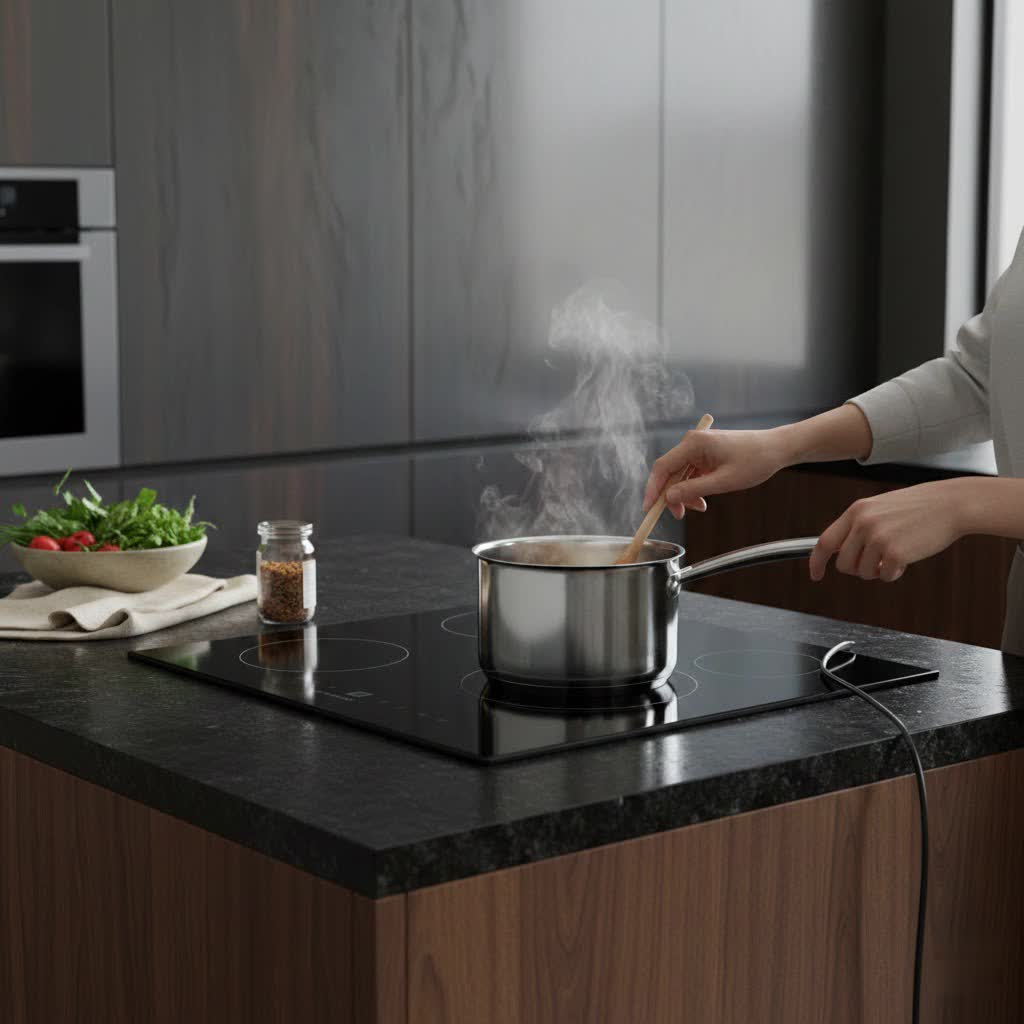
An induction cooktop represents a significant leap forward from traditional gas or electric stoves, harnessing electromagnetic fields to generate heat directly within your cookware. This innovative approach offers unparalleled speed, efficiency, and safety, making it a favorite for contemporary kitchens. Understanding its core principles is key to appreciating the Samsung Bespoke’s capabilities.
How Induction Cooktops Work
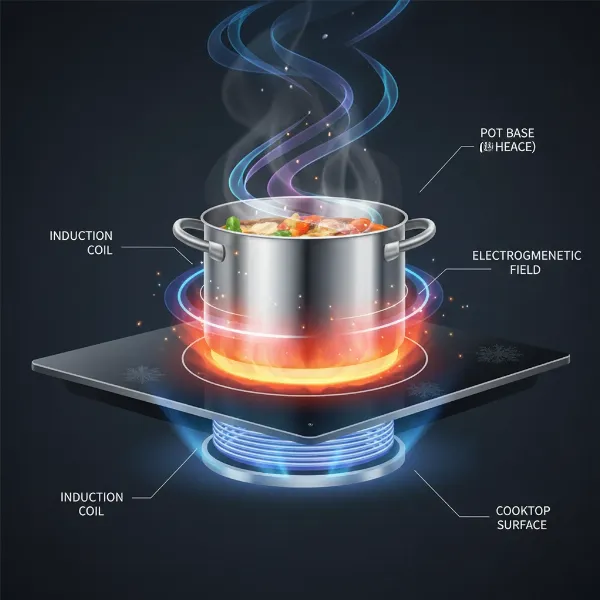
Table is empty.At the heart of an induction cooktop’s operation are electromagnetic coils located beneath a smooth, ceramic glass surface. When an induction-compatible pan is placed on a cooking zone and the power is activated, an alternating electric current flows through these coils, creating a fluctuating magnetic field. This field induces an electric current directly into the base of the cookware, causing it to heat up rapidly. Crucially, the cooktop surface itself does not become hot, only the pan, leading to minimal heat loss and a significantly cooler kitchen environment.
Structure of an Induction Cooktop
Typically, an induction cooktop consists of a robust glass-ceramic surface that is both aesthetically pleasing and easy to clean. Beneath this surface are the induction coils, often made of copper, along with sophisticated electronic controls and a cooling fan to regulate internal temperatures. The Samsung Bespoke model, for instance, features a durable matte glass cooktop designed to resist scratches, housing four powerful burners, two of which can be combined to form a larger bridge burner for accommodating oversized cookware. The entire system is managed via a sleek, intuitive touchscreen control panel.
Advantages and Disadvantages of Induction Cooktops Compared to Other Types
Induction cooktops offer several compelling advantages over their gas and traditional electric counterparts:
- Speed and Precision: Induction heats food significantly faster than gas or electric, boiling water in mere minutes. It also provides instant and precise temperature control, similar to gas but with finer adjustments.
- Energy Efficiency: Because heat is generated directly in the cookware, very little energy is wasted, making induction highly energy-efficient.
- Safety: The cooktop surface remains relatively cool, reducing the risk of accidental burns. Most induction cooktops also feature automatic pan detection and shut-off functions.
- Easy to Clean: Spills don’t bake onto the cool surface, making cleanup as simple as a quick wipe.
- Improved Air Quality: Unlike gas, induction cooking does not release combustion byproducts into the air, contributing to a healthier indoor environment.
However, there are also a few considerations:
- Cookware Requirements: Induction cooktops only work with ferromagnetic (magnetic) cookware. This may necessitate an investment in new pots and pans if your current collection is not compatible.
- Initial Cost: Induction cooktops generally have a higher upfront cost than gas or standard electric models.
- Learning Curve: Users accustomed to gas or electric might need a brief adjustment period to master the rapid heating and precise controls of induction.
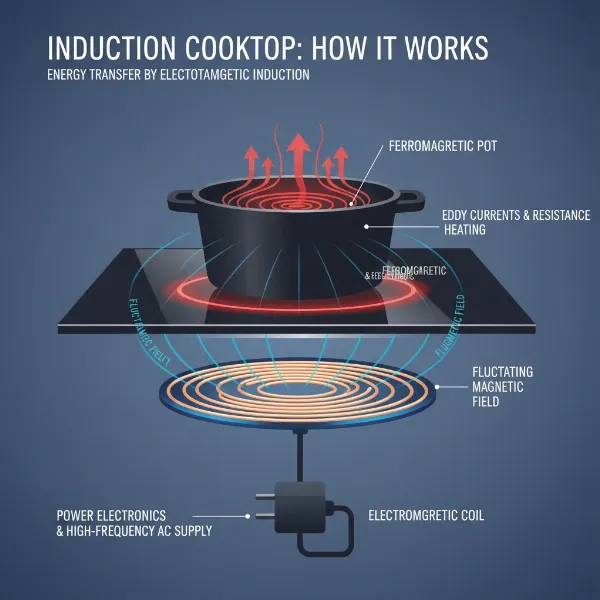 An illustrative diagram of induction cooktop technology showing electromagnetic coils heating a pot directly.
Types of Induction Cooktops
Induction cooktops come in various configurations to suit diverse kitchen layouts and cooking preferences. While the Samsung Bespoke Smart Induction Cooktop is typically integrated as part of a range, it embodies features found across different types.
By Number of Cooking Zones
Induction cooktops vary in the number of burners or cooking zones they offer:
- Single Induction Cooktop: Portable, ideal for small spaces or as an auxiliary burner.
- Double Induction Cooktop: Offers two cooking zones, suitable for smaller households or limited counter space.
- Multi-Zone Induction Cooktops (3, 4, or more zones): Most common for built-in or range models, providing ample space for multiple dishes. The Samsung Bespoke Smart Induction Cooktop typically features four powerful burners, including the versatile bridge burner function to create a larger cooking area.
By Design
The aesthetic and installation method are key distinctions:
- Built-in (Drop-in) Induction Cooktops: These are designed to be flush-mounted into a countertop, offering a seamless and integrated look.
- Freestanding Induction Ranges: Combine an induction cooktop with an oven in a single unit, providing a complete cooking solution. The Samsung Bespoke Smart Induction Cooktop reviewed here is typically found in a slide-in or freestanding range format, blending the cooktop with a sophisticated oven.
By Features
Modern induction cooktops boast an array of advanced features:
- Inverter Technology: Provides more stable and consistent heat at lower settings, preventing scorching and improving simmering.
- Booster Function: Delivers an extra burst of power to a cooking zone for rapid boiling or searing, a notable feature in the Samsung Bespoke cooktop for quickly heating liquids.
- Automatic Cooking Modes: Pre-set programs for specific dishes.
- Smart Connectivity: Wi-Fi and app integration for remote control, monitoring, and personalized assistance, which is a hallmark of the Samsung Bespoke series.
Comparison Table of Popular Induction Cooktop Brands
The market for induction cooktops is robust, with several manufacturers offering innovative features and designs. Here’s a comparison of some popular brands, highlighting key aspects often considered by discerning buyers.
| Feature / Brand | Samsung Bespoke Smart Induction Cooktop | Bosch Benchmark Series Induction Cooktop | GE Smart Induction Cooktop | Thermador Liberty Induction Cooktop | Miele Induction Cooktop (e.g., KM 7745 FL) | Gaggenau Induction Cooktop (e.g., CX 482) |
|---|---|---|---|---|---|---|
| Key Differentiator | AI-powered smart features, customizable design, matte glass | Precision, power, flexible zones, Home Connect | Intuitive controls, smart cookware integration | Large flexible cooking surface, pan recognition | Durable, high quality, flexible zones | Highest reliability, full surface induction |
| Power (Peak kW) | 4.3 kW (main burner) | High-power (up to 5.5 kW on some zones) | Varies by model (e.g., 3.7 kW) | Up to 4.6 kW | Varies by model (e.g., 7.4 kW total) | Up to 7.4 kW total |
| Control Type | 7-inch Full Touch Screen, no knobs | Touch sensitive, precise power levels | Touch controls, app access | Touch controls with Sapphire Glow LEDs | Touch controls | Full-surface touch display |
| Cooking Zones | 4 (2 can be bridged) | Flex induction zones, usually 4 | 4-5 zones, some with bridge | Up to 6 elements anywhere on surface | 3 flexible areas, auto pan recognition | Full surface, up to 6 pots/pans simultaneously |
| Smart Features | SmartThings, AI Home, Bixby voice, remote control, recipes | Home Connect app, remote monitoring | App access, potential for smart cookware | Wi-Fi connectivity | Limited smart features | Home Connect app, remote control |
| Design | Sleek, Bespoke aesthetic, anti-scratch matte glass | Seamless integration, black ceramic glass | Modern, clean lines | Frameless design, elegant | Minimalist, high-end materials | Minimalist, professional-grade |
| Reliability | Good (as part of Samsung’s appliance reputation) | Very High (1.7% service rate) | Good | High (4.9% service rate) | Good (9.8% service rate) | Excellent (0% service rate) |
| Price Range | High-end | Premium | Mid to High-end | Luxury | Luxury | Ultra-luxury |
Note: Reliability rates are based on Yale Appliance Blog’s 2025 data and should be considered as a general guide.
Guide to Choosing the Right Induction Cooktop
Selecting an induction cooktop requires careful consideration of your lifestyle, cooking habits, and kitchen design. Making an informed decision ensures you invest in an appliance that truly enhances your culinary journey.
Determine Usage Needs
Start by evaluating who will be using the cooktop and how frequently:
- Family Size: A single or double cooktop might suffice for individuals or couples, while families often benefit from 4 or more cooking zones, like those found on the Samsung Bespoke.
- Cooking Frequency: If you cook daily or entertain often, a model with a bridge burner, booster functions, and robust smart features will be more beneficial.
- Types of Dishes: Consider if you need precise simmering for sauces, high power for searing, or flexible zones for large griddles.
Select Size and Design Cooktop to Fit Your Kitchen Space
Induction cooktops are available in various sizes (e.g., 24, 30, 36 inches) and installation types:
- Countertop Space: Measure your available counter space carefully. For built-in models, ensure the cutout dimensions match the cooktop’s specifications.
- Aesthetics: Decide between a sleek built-in unit or a combined induction range. The Samsung Bespoke offers a slide-in design that provides a premium, integrated look.
- Control Placement: Some cooktops have front-mounted controls, others have side controls. The Bespoke features a convenient front-mounted touchscreen.
Consider Power, Features, and Technology of the Cooktop
Modern induction cooktops are packed with innovations:
- Power Levels: Look for a cooktop with a high maximum power output (kW) for rapid heating, and fine-grained control for delicate tasks. The Samsung Bespoke’s 4.3kW main burner is excellent for quick boils.
- Booster Function: This feature provides an extra surge of power, significantly reducing heating times.
- Smart Connectivity: If smart home integration appeals to you, prioritize models with Wi-Fi, app control (like Samsung SmartThings), voice assistant compatibility, and recipe guidance.
- Safety Features: Auto shut-off, child lock, and hot surface indicators are crucial safety elements.
- Noise Cancellation: Features like the Samsung Bespoke’s Dual Noise Cancellation contribute to a more peaceful cooking environment.
Choose a Reputable Brand and Good Warranty
Investing in a major appliance means considering the manufacturer’s reputation and support:
- Brand Reputation: Stick to well-established brands known for quality and innovation. Samsung is a leading brand in home appliances.
- Warranty and Support: A standard warranty (typically one year for parts and labor) is expected. Check customer service reviews and the availability of local service technicians. Many brands also offer extended warranty options.
Top Samsung Bespoke Smart Induction Cooktop (Detailed Review)
The Samsung Bespoke Smart Induction Cooktop, often integrated into a slide-in range, represents a fusion of high-performance cooking, elegant design, and intelligent connectivity. It’s designed for those who seek not just an appliance, but a smart hub for their kitchen.
Samsung Bespoke Smart Induction Cooktop: A Closer Look
The Samsung Bespoke Induction Cooktop is characterized by its sophisticated aesthetic and innovative features. It often boasts a sleek matte glass surface that is 54% more scratch-resistant than conventional glass, ensuring it maintains its pristine appearance even with regular use. The cooktop provides four powerful cooking zones, with the flexibility to bridge two burners for larger pots or griddles, catering to diverse culinary needs.
Key Features and Performance:
- Powerful Performance: With a 4.3kW main induction burner, it delivers exceptional heating speed, capable of boiling a large pot of water in under five minutes. This speed is a significant upgrade from traditional cooking methods.
- Precise Control: The induction technology offers instant and precise temperature adjustments, giving you ultimate control over your cooking, from a delicate simmer to a high-heat sear.
- Intuitive Touchscreen Control: The cooktop is managed via a vibrant 7-inch full-touch screen. This intuitive interface eliminates physical knobs, offering a clean look and easy navigation between settings, power levels (1-9), and individual timers.
- SmartThings Integration: At the core of its “smart” capabilities is the integration with Samsung’s SmartThings ecosystem. This allows for remote monitoring and control via your smartphone, personalized recipe recommendations, meal planning, and even connecting with other smart home devices like Ring cameras for a truly connected kitchen experience. Voice activation through Bixby adds hands-free convenience.
- Dual Noise Cancellation: A notable innovation, this technology automatically reduces the operational noise often associated with induction cooktops, providing a quieter and more pleasant cooking environment.
- Easy to Clean: The cool-to-the-touch induction surface and fingerprint-resistant finish (on certain models like stainless steel) make cleaning effortless. Spills wipe away without burning on.
Pros:
- Exceptional heating speed and precise temperature control.
- Sleek, modern Bespoke design with a scratch-resistant matte glass cooktop.
- Advanced smart features and seamless SmartThings integration.
- Intuitive 7-inch touchscreen for easy operation.
- Dual Noise Cancellation for a quieter cooking experience.
- Bridge burner function for versatile cooking with larger cookware.
- Enhanced safety features due to induction technology.
Cons:
- Higher price point compared to conventional cooktops.
- Requires induction-compatible cookware.
- Users new to induction or full-touch controls may experience a slight learning curve.
- Some advanced smart features are more relevant to the oven component if purchased as part of a range.
Target Audience:
The Samsung Bespoke Smart Induction Cooktop is ideal for tech-savvy home chefs, design-conscious individuals, and anyone looking for a high-performance, efficient, and safe cooking solution that integrates seamlessly into a smart home ecosystem. It appeals to those who value both form and function in their kitchen appliances.
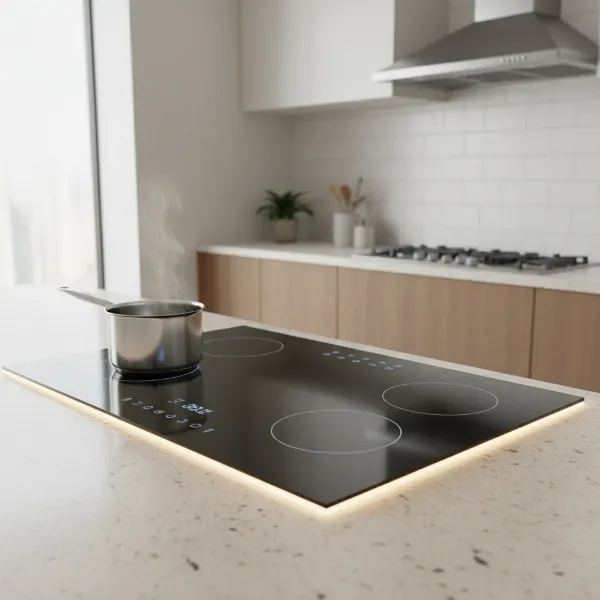 A close-up of the Samsung Bespoke Smart Induction Cooktop's sleek design and digital touchscreen control panel.
How to Use and Maintain Your Induction Cooktop Correctly
Maximizing the lifespan and performance of your Samsung Bespoke Smart Induction Cooktop involves understanding its operation and adhering to proper maintenance routines.
How to Use the Functions of an Induction Cooktop
Using the Samsung Bespoke Smart Induction Cooktop is straightforward thanks to its intuitive 7-inch touchscreen:
- Power On/Off: Simply touch the power button on the screen to activate or deactivate the cooktop.
- Select a Burner: Tap the graphic representation of the desired cooking zone on the screen.
- Adjust Power: Use the slider or +/- buttons on the touchscreen to select your desired heat level, typically ranging from 1 to 9. The boost function can be activated for rapid heating.
- Set Timers: Individual timers can be set for each burner directly through the touchscreen, offering precise control over cooking duration.
- Smart Features: Utilize the SmartThings app on your smartphone to remotely monitor settings, get recipe recommendations, or even use voice commands via Bixby.
Cleaning and Maintaining Your Induction Cooktop
The smooth glass surface of the induction cooktop makes cleaning remarkably simple:
- Daily Cleaning: After the cooktop has cooled (though it cools quickly), wipe the surface with a damp cloth and mild dish soap to remove minor spills and splatters. A microfiber cloth can buff it dry to prevent streaks.
- Stubborn Stains: For tougher, burnt-on food (though less common with induction), use a specialized ceramic cooktop cleaner. Apply a small amount, let it sit for a few minutes, then scrub gently with a non-abrasive pad or scraper designed for glass cooktops. Wipe clean and buff dry.
- Avoid Abrasives: Do not use abrasive cleaners, scouring pads, or harsh chemicals, as these can scratch the glass surface.
- Check Vents: Ensure the ventilation openings (if any) are clear of debris to prevent overheating.
Safety Notes When Using an Induction Cooktop
While induction is inherently safer than gas or electric, keeping these points in mind is beneficial:
- Compatible Cookware: Always use induction-compatible pots and pans (those with a magnetic base). Using non-compatible cookware will result in the cooktop not heating.
- Avoid Empty Pots: Do not leave empty pots on a hot burner, especially with the boost function, as it can potentially damage the cookware or cooktop.
- Child Lock: Utilize the child safety lock feature on the control panel to prevent accidental activation.
- Clear the Surface: Keep the cooktop clear of flammable materials when in use.
- Pace Makers: Individuals with pacemakers should consult their doctor before using an induction cooktop, although modern induction cooktops are generally designed to be safe.
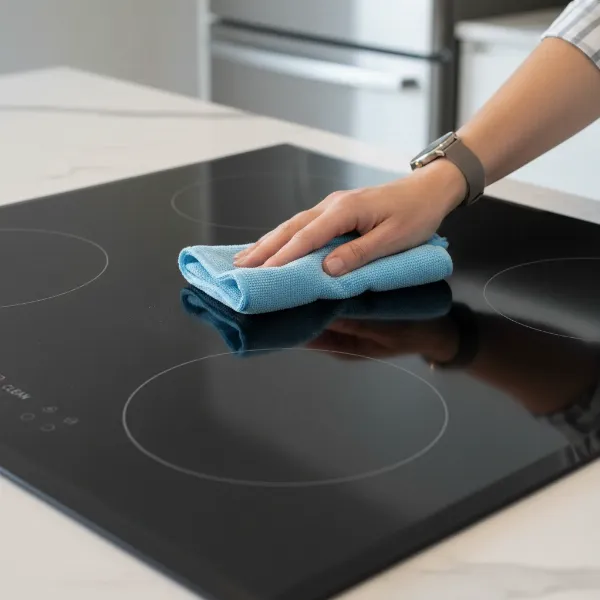 A hand cleaning the sleek glass surface of an induction cooktop with a soft cloth, highlighting its ease of maintenance.
Tips for Dealing with Common Induction Cooktop Problems
While generally reliable, induction cooktops can occasionally encounter issues. Knowing how to troubleshoot common problems can save you time and hassle.
Cooktop Not Heating
If your induction cooktop isn’t heating, check these potential causes:
- Incompatible Cookware: The most frequent reason. Ensure your pot or pan has a magnetic base. Test with a magnet – if it sticks firmly to the bottom, it’s compatible.
- Incorrect Placement: Make sure the cookware is centered on the cooking zone and fully covers the induction element’s minimum diameter.
- Power Supply Issue: Check if the cooktop is properly plugged in and if there’s a power outage or tripped circuit breaker.
- Small Cookware: Very small pots or pans might not be detected by the induction element.
Cooktop Reports an Error
Modern induction cooktops, including the Samsung Bespoke, often display error codes to indicate a problem:
- Consult the Manual: The first step is always to refer to your cooktop’s user manual. Each error code corresponds to a specific issue and provides troubleshooting steps.
- Common Error Causes: Errors often relate to incompatible cookware, overheating (due to prolonged high-heat use without contents or blocked vents), or internal electrical issues.
- Reset the Cooktop: Sometimes, simply turning the cooktop off and on again, or unplugging it for a few minutes, can clear a temporary error.
- Professional Service: If an error persists after basic troubleshooting, it’s best to contact customer support or a qualified technician for repair.
Cracked Glass Surface
While induction cooktop surfaces are designed to be durable, severe impact or stress can lead to cracks:
- Prevention: Avoid dropping heavy items on the cooktop surface. Do not place extremely hot cookware directly from the oven onto a cold induction surface, or vice-versa, as sudden temperature changes can cause thermal shock.
- Immediate Action: If the glass surface cracks, immediately turn off the cooktop and disconnect it from the power supply to prevent electric shock.
- Professional Repair: A cracked cooktop surface should not be used. It requires replacement by a qualified service technician. Attempting to use a damaged cooktop is a safety hazard.
Comparison Between Induction Cooktop and Ceramic Cooktop
When choosing a new cooking appliance, the debate often narrows down to induction versus radiant ceramic electric cooktops. Both offer a sleek, flat surface, but their underlying technology and performance differ significantly.
| Feature | Induction Cooktop | Radiant Ceramic/Electric Cooktop |
|---|---|---|
| Principle | Uses electromagnetic fields to heat cookware directly | Uses electric resistance elements to heat glass surface, then cookware |
| Heating Speed | Extremely fast (boils water in minutes) | Slower (heats surface first, then transfers to pan) |
| Energy Efficiency | Very high (minimal heat loss) | Moderate (significant heat loss to ambient air) |
| Temperature Control | Instantaneous and precise | Slower response to changes, less precise |
| Safety | Surface remains cool (only pan heats), auto shut-off | Surface remains hot after use, higher burn risk |
| Cleanup | Easiest (spills don’t burn onto cool surface) | Can be challenging (spills bake onto hot surface) |
| Cookware | Requires magnetic (ferromagnetic) cookware | Works with all flat-bottomed cookware |
| Noise Level | Can produce a faint hum or fan noise (e.g., Samsung Dual Noise Cancellation) | Generally silent |
| Price | Higher initial cost | Lower initial cost |
| Heat Indicator | Hot surface indicator lights | Hot surface indicator lights (often stays on longer) |
Summary of Differences:
Induction cooktops offer superior speed, precision, energy efficiency, and safety compared to radiant ceramic electric cooktops. The direct heating method makes them exceptionally responsive and easier to clean. However, they require specific cookware and typically come with a higher price tag. Ceramic cooktops are a more budget-friendly option that works with any flat-bottomed cookware, but they are less efficient, slower to respond, and retain heat for longer, posing a higher burn risk. For those prioritizing performance, safety, and modern features, induction, particularly a smart model like the Samsung Bespoke, is generally the preferred choice.
Frequently Asked Questions When Using an Induction Cooktop
Navigating the world of induction cooking often brings up common queries. Here are answers to some of the most frequently asked questions.
Is induction cooking safe for everyone?
Induction cooking is generally very safe due to the cooktop surface remaining cool. However, individuals with pacemakers should consult their doctor before using an induction cooktop due to the electromagnetic fields involved, though most modern appliances are designed to mitigate risks.
Why do my induction cooktop and pots make noise?
It’s common for induction cooktops to produce a faint hum, buzz, or clicking sound. This is usually due to the cooling fan, the vibration of the pot’s layers, or the electromagnetic field adjusting to the cookware. The Samsung Bespoke features Dual Noise Cancellation to minimize these sounds.
Can I use all my old pots and pans on an induction cooktop?
No, only cookware with a magnetic (ferromagnetic) base is compatible with induction cooktops. You can test your pots and pans with a magnet; if it sticks firmly to the bottom, it will work. Materials like cast iron, magnetic stainless steel, and enamel-on-steel are generally compatible.
How long do induction cooktops last?
With proper care and maintenance, induction cooktops can last between 10 to 15 years, similar to other high-quality kitchen appliances. Factors like usage frequency, cleaning habits, and quality of manufacturing play a significant role.
Is an induction cooktop expensive to run?
While the initial cost of an induction cooktop can be higher, they are generally more energy-efficient to run than gas or traditional electric cooktops. Their direct heating method minimizes wasted energy, potentially leading to lower electricity bills over time.
How do I know if my induction cooktop is too hot?
Induction cooktops themselves do not get hot from the elements, but the residual heat from the hot pot can transfer to the glass surface. Most induction cooktops have a hot surface indicator light that remains on until the surface is safe to touch. Always wait for this light to turn off.
What is a bridge element on an induction cooktop?
A bridge element (or sync burner) allows two separate cooking zones to be linked together and controlled as one large zone. This is ideal for using oversized pots, griddles, or oblong cookware that wouldn’t fit on a single burner, enhancing cooking flexibility.
Where to Buy a Reliable Induction Cooktop?
Finding a reliable induction cooktop, especially a sophisticated model like the Samsung Bespoke, requires knowing where to look for reputable sellers and good customer support.
Physical Appliance Stores
- Major Appliance Retailers: Large stores such as Best Buy, Lowe’s, and The Home Depot often have a wide selection of induction cooktops and ranges from various brands, including Samsung. They typically have floor models you can examine, and sales associates can provide information and arrange for delivery and installation.
- Specialty Appliance Showrooms: These stores often offer a more curated selection of high-end appliances and knowledgeable staff who can provide in-depth comparisons and personalized recommendations.
Online Retailers
- Brand Websites: Samsung’s official website is an excellent place to find the latest Bespoke Smart Induction Cooktop models, detailed specifications, and sometimes exclusive promotions.
- E-commerce Giants: Websites like Amazon, Wayfair, and Abt carry a vast array of induction cooktops, often with competitive pricing and customer reviews that can aid your decision-making. Be sure to verify seller reputation and warranty information.
- Retailer Online Stores: The online portals of major appliance retailers offer the convenience of shopping from home, often with options for in-store pickup or home delivery and installation services.
When purchasing, always compare prices, check the return policy, inquire about warranty details, and consider professional installation to ensure your new induction cooktop is set up correctly and safely.
Conclusion
The Samsung Bespoke Smart Induction Cooktop stands as a testament to modern kitchen innovation, offering a compelling blend of speed, precision, and intelligent design. Its scratch-resistant matte glass surface, powerful induction zones, and intuitive touchscreen controls deliver a superior cooking experience, while seamless integration with Samsung SmartThings transforms your kitchen into a connected culinary hub. While it represents a premium investment and requires specific cookware, the benefits in terms of efficiency, safety, and smart features are substantial. This cooktop is more than just an appliance; it’s a statement piece designed to empower your cooking and elevate your daily life.
Are you ready to embrace the future of cooking with the Samsung Bespoke Smart Induction Cooktop?